Skip to product information
1 of 1

The Color of Law: A Forgotten History of How Our Government Segregated America: A Forgotten History of How Our Government Segregated America

The Color of Law: A Forgotten History of How Our Government Segregated America: A Forgotten History of How Our Government Segregated America

Richard Rothstein

Regular price $17.95 USD
Regular price $17.95 USD Sale price $17.95 USD
Sale Sold out
Shipping calculated at checkout.
Quantity

Product Info

ISBN: 9781631494536

Publisher: Liveright Publishing Corporation

Publication Date: 5/1/18

Binding: Paperback

Age Range: -

Grade Range: NA-NA

Series: ,

Pages:

Language: English

BISAC: History, United States, 20th Century, Social Science, Discrimination (incl. Prejudice, Racism, Colorism, etc.), Political Science, American Government, History & Theory, General, Law, Housing & Urban Development, Public Policy, and City Planning & Urban Development

Related Subjects: Segregation, United States, History, 20th century, African Americans, Discrimination in housing, Government policy, and Race relations

View full details

Description

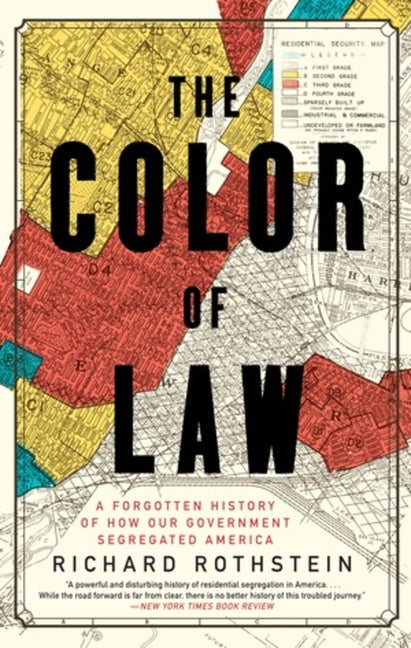
Widely heralded as a "masterful" (Washington Post) and "essential" (Slate) history of the modern American metropolis, Richard Rothstein's The Color of Law offers "the most forceful argument ever published on how federal, state, and local governments gave rise to and reinforced neighborhood segregation" (William Julius Wilson). Exploding the myth of de facto segregation arising from private prejudice or the unintended consequences of economic forces, Rothstein describes how the American government systematically imposed residential segregation: with undisguised racial zoning; public housing that purposefully segregated previously mixed communities; subsidies for builders to create whites-only suburbs; tax exemptions for institutions that enforced segregation; and support for violent resistance to African Americans in white neighborhoods. A groundbreaking, "virtually indispensable" study that has already transformed our understanding of twentieth-century urban history (Chicago Daily Observer), The Color of Law forces us to face the obligation to remedy our unconstitutional past.

Staff Reviews

-

-